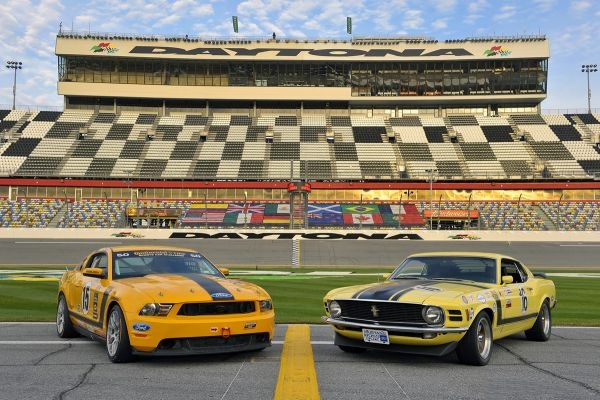
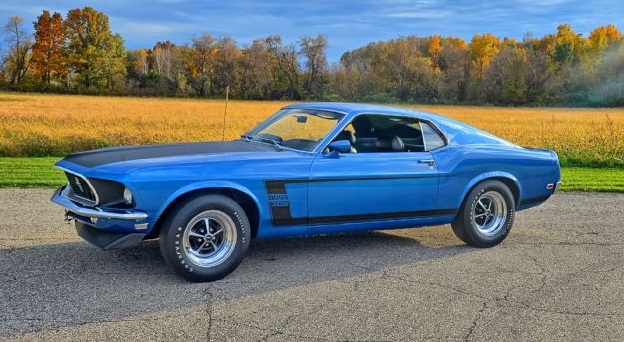
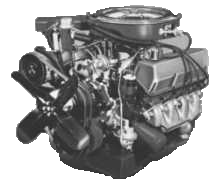
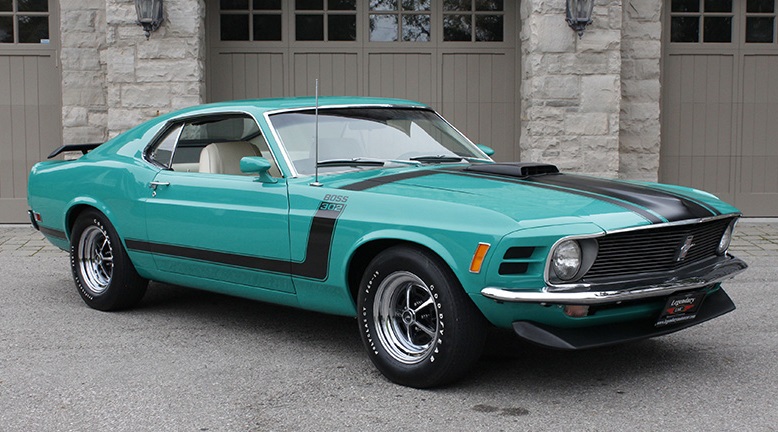
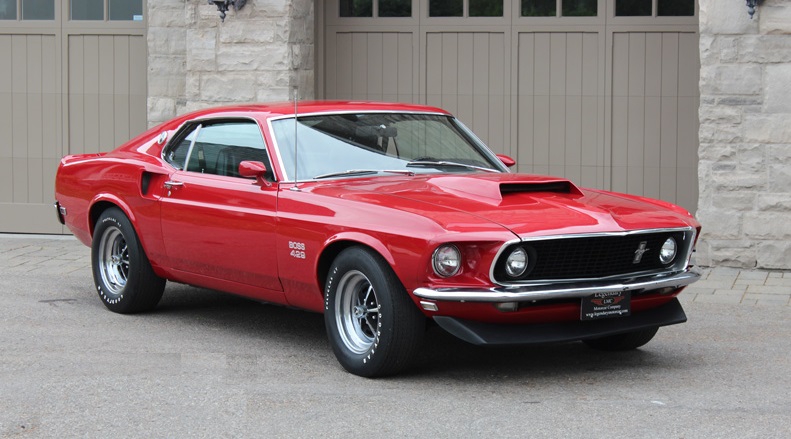
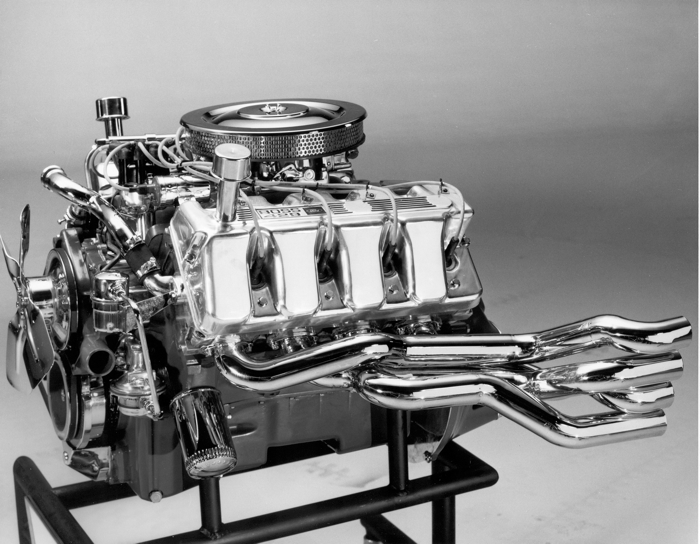
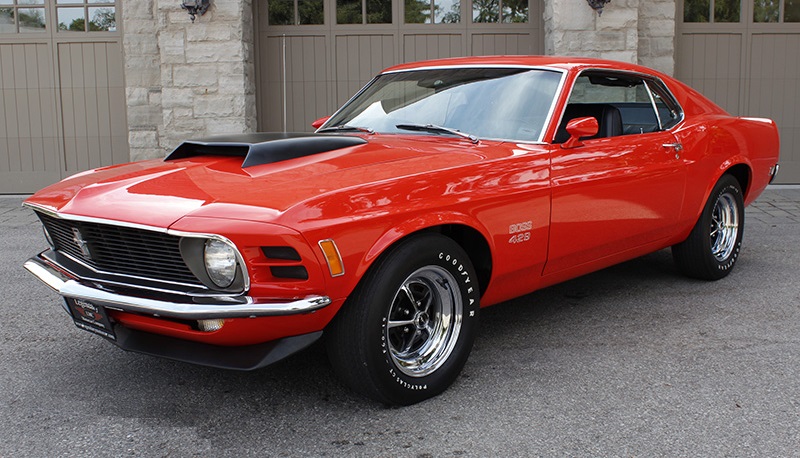
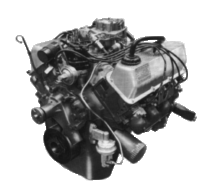
The Boss 429 Mustang debuted in January of 1969. It was built primarily to allow Ford to campaign the special engine in the NASCAR racing circuit. NASCAR's rules stated that for any "trick" part or engine to be considered legal, it had to be installed on at least 500 cars that were sold to the public. The Mustang SportsRoof model was chosen to house this brutal engine. The Boss 429 engine was rated at over 370 horsepower. It featured aluminum heads, with huge, free-flowing intake and exhaust ports, a crescent shaped combustion chamber, and large over-sized valves which were set at an angle so that the intake valve was close to the intake manifold and the exhaust valve was close to the exhaust manifold. The standard 735 CFM Holley carburetor was mounted on a high rise intake manifold. To allow for the extended width of this new engine, the factory shock towers had to be moved out one inch on each side. A "mini-assembly plant" in Brighton, Michigan called Kar Kraft, performed this and other modifications for the Boss 429 Mustangs. The partially assembled Mustang SportsRoofs were shipped from Ford to Kar Kraft for modification and final assembly. Kar Kraft lowered the front A-Arms one inch, moved the shock towers out one inch, and installed the Boss 429 engines along with a high-capacity oil cooler. The exterior of the Boss 429 Mustang featured a massive, manually operated, ram air hood scoop (the largest ever installed on a Mustang). The scoop was painted the same color as the body in '69 and black on the '70 models. A front spoiler, flared front fenders, chrome 15x7 Magnum 500's with F60x15 wide oval tires, dual color-keyed racing mirrors and Boss 429 decals on the front fenders were all standard equipment on the Boss 429's. The interior of the Boss 429 Mustang was outfitted with the interior decor group, high back "Comfortweave" buckets, the "Visibility Group" (parking brake warning light, glove box lock, lights in the ash tray, trunk, and glove box, and an illuminated ignition switch), deluxe seat belts, console, tachometer, and a Ford 4 speed shifter. In 1970 Ford also included the "Convenience Group" as standard equipment on the Boss 429. The "Convenience Group" added a parking brake warning light, headlights-on warning buzzer, and an automatic seat back release. Other standard features on the Boss 429 were a competition suspension, rear stabilizer bar, high capacity engine oil cooler, 65 amp alternator, 85 amp battery (mounted in the trunk), lowered front A-Arms, power front disc brakes, power steering and a 3.91:1 Traction-Lok rear end. 1971 Ford Mustang Boss 351
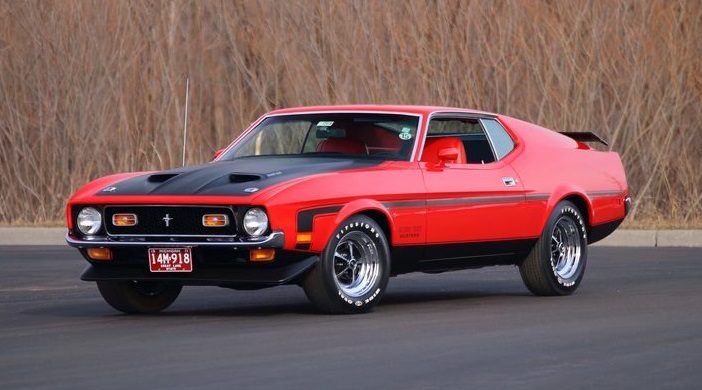
Introduced in November of 1970, the Boss 351 Mustang became one of the last high performance models of the Mustang line. It was based on the Mustang SportsRoof model and replaced both the Boss 302 and the Boss 429 models. The Boss 351 engine was a 351 Cleveland four barrel engine with a mechanical cam, solid lifters, 11.0:1 compression ratio, aluminum intake, and a 4 bolt main bearing block. It was topped with an all-new 750 CFM Ford 4 barrel carburetor. The Boss 351 engine produced 330 horsepower at 5400 RPM. The exterior of the Boss 351 Mustang featured a functional Ram Air NASA hood with built in twist-type locks and was painted either black or argent depending upon exterior color, a front spoiler in either black or argent, a honeycomb grille, color-keyed hood and fender mouldings, a black or argent rear panel, dual color-keyed racing mirrors, a body side stripe, and "Boss 351 Mustang" decals on the fenders and deck lid. The standard wheels were 15x7 steel wheels with flat hub caps and F60x15 tires. Most buyers, however, opted for the chrome or argent Magnum 500's. The Boss 351 Mustang was equipped with the standard Mustang interior, but any of the optional Mustang interiors could be ordered. A Hurst 4 speed shifter and the "Instrumentation Group" (tachometer, and tripod gauges with oil pressure, alternator, and temperature) were standard on the Boss 351 interior. Other standard Boss 351 equipment included a four speed transmission, competition suspension with staggered rear shocks, heavier front stabilizer bar, power front disc brakes, extra-capacity radiator, dual exhaust, an 80 amp battery, and 3.91:1 Traction-Lok rear end. Copyright © 2019 Class 1 Classic Cars, LLC. All Rights Reserved |